
AI Search vs Traditional Search: What's Changing?
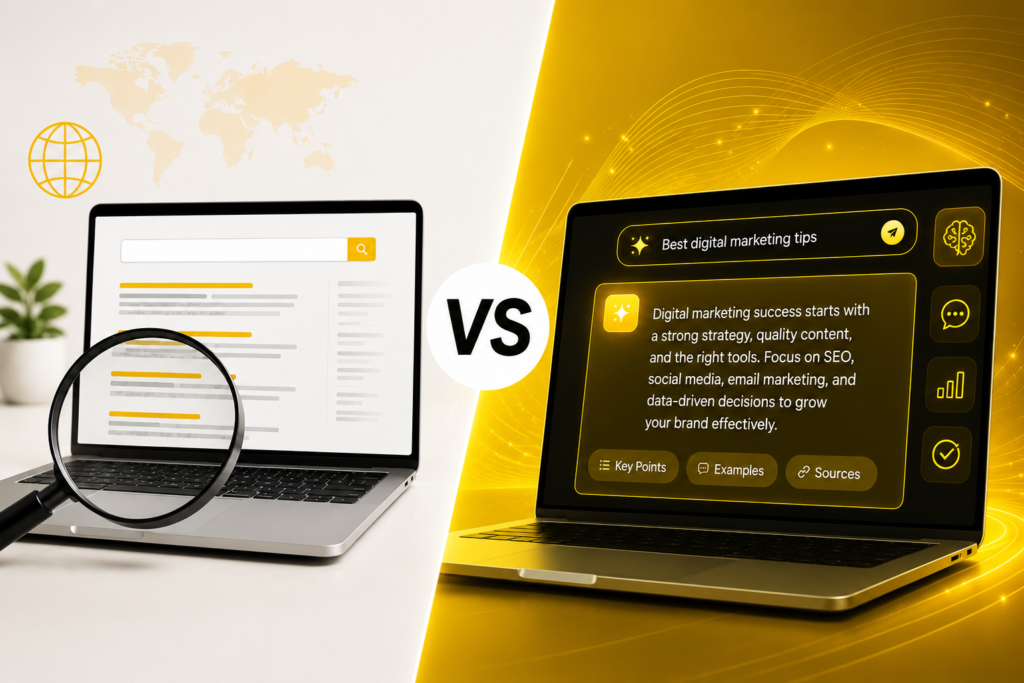
AI Search vs Traditional Search: What’s Changing?
Introduction
The way people search for information online is evolving faster than ever. For years, traditional search engines like Google relied on keywords and rankings to display a list of relevant web pages. Today, artificial intelligence (AI) is transforming that experience by providing direct, conversational answers instead of just links.
With AI-powered search tools such as ChatGPT, Google AI Overviews, Microsoft Copilot, and Perplexity AI becoming more popular, businesses and marketers need to rethink how they create content and optimize their websites.
So, what exactly is changing? Let’s explore the key differences between AI search and traditional search—and what it means for the future of digital marketing.
What Is Traditional Search?
Traditional search engines work by crawling, indexing, and ranking web pages based on hundreds of ranking factors.
How It Works
User enters a keyword.
Search engine analyzes the query.
Relevant websites are ranked.
Users choose which result to click.
For example, if you search:
“Best digital marketing course”
Google typically displays:
Organic search results
Paid advertisements
Featured snippets
Videos
Images
People Also Ask sections
The user must visit different websites to find the complete answer.
What Is AI Search?
AI search uses large language models (LLMs) to understand the meaning and intent behind a user’s question. Instead of only listing websites, it generates a direct answer by combining information from multiple sources.
Examples include:
ChatGPT
Google AI Overviews
Microsoft Copilot
Perplexity AI
For example, asking:
“Which digital marketing course is best for beginners with no experience?”
An AI search tool may immediately provide:
Recommended courses
Comparison table
Advantages and disadvantages
Learning roadmap
Estimated costs
Useful resources
The user often gets an answer without opening several web pages.
AI Search vs Traditional Search
Feature
Traditional Search
AI Search
Results
List of web pages
Direct AI-generated answers
Search Method
Keywords
Natural language and context
User Experience
Requires multiple clicks
Instant summarized response
Personalization
Limited
More conversational and context-aware
Content Discovery
Website-focused
Information-focused
Interaction
One search at a time
Ongoing conversation
What’s Changing?
1. Search Is Becoming Conversational
Instead of typing:
“SEO checklist”
People now ask:
“Can you give me an SEO checklist for a small business website?”
AI understands context and provides more personalized responses.
2. Keywords Are No Longer Everything
Traditional SEO focused heavily on exact-match keywords.
Today, AI understands:
Context
Intent
Related topics
Synonyms
Content should answer real questions, not just repeat keywords.
3. Quality Content Matters More Than Ever
AI systems prioritize content that is:
Helpful
Accurate
Well-structured
Easy to understand
Written with expertise
Thin or low-quality content is less likely to be useful to users—or referenced by AI-powered systems.
4. Zero-Click Searches Are Increasing
Users often receive answers directly on the search page through AI-generated summaries or search features, reducing the need to click through to websites.
This means marketers should focus on creating content that is valuable enough to earn visibility and trust when AI systems summarize information.
5. Search Intent Is More Important
Instead of targeting one keyword, marketers should understand why users are searching.
For example:
Keyword:
“Email Marketing”
User intents might include:
Learning what email marketing is
Finding the best software
Improving email open rates
Creating an email campaign
Creating content that satisfies different intents can improve its usefulness.
What Does This Mean for SEO?
SEO is evolving—it isn’t disappearing.
Modern SEO should include:
Comprehensive, helpful articles
Clear headings and structure
Credible information
Original insights and examples
Fast-loading, mobile-friendly websites
Strong user experience
The goal is to create content that serves people first.
Tips for Digital Marketers
To adapt to AI search:
Focus on solving real user problems.
Write in clear, conversational language.
Cover topics comprehensively.
Use logical heading structures.
Keep information up to date.
Build credibility with accurate, trustworthy content.
Continue improving technical SEO fundamentals.
The Future of Search
The future will likely combine AI-generated answers with traditional search results. Search engines are becoming assistants that help users make decisions rather than simply displaying lists of links.
Businesses that create useful, trustworthy, and user-focused content will be better positioned as search continues to evolve.
Conclusion
AI search is changing how people discover information online. While traditional search remains important, AI-powered experiences are making search faster, more conversational, and more focused on delivering answers.
For digital marketers, success now depends on understanding user intent, creating high-quality content, and adapting SEO strategies to meet changing search behaviors.
Those who embrace these changes today will be better prepared for the future of digital marketing.